


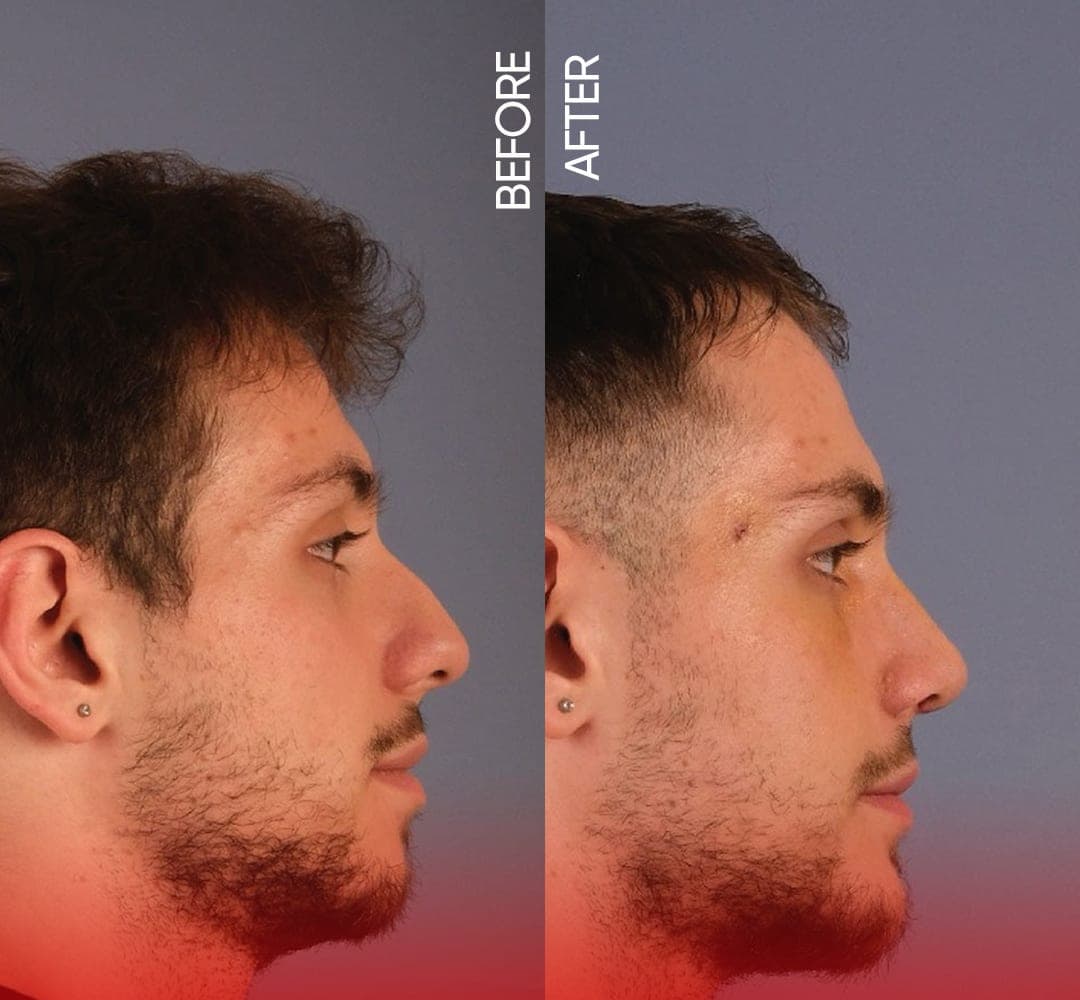
Profile, at six months
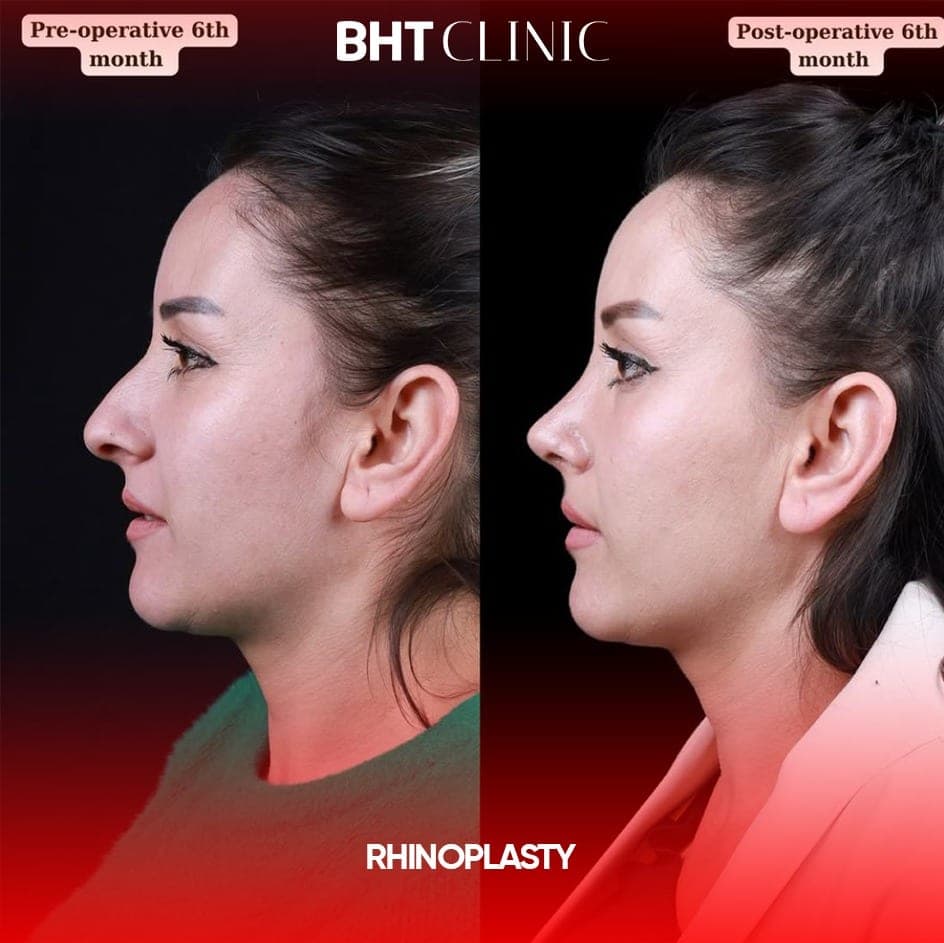
The same profile before surgery and at the sixth month — a straighter bridge line and a tip sitting higher than it did. Six months is roughly when the shape reads as settled; the last of the swelling takes longer than that.
15+ years of surgery. 10,000+ patients treated across all departments of a JCI-accredited hospital in İstanbul. Your nose is planned with you before theatre using 3D imaging, then reshaped through an open or a closed approach with piezo ultrasonic instruments — and hotel, VIP transfers, an English-speaking coordinator or translator and aftercare are included for international guests.
Accredited & certified


Free assessment
Your name and number — then we'll send your personalised plan on WhatsApp.
Your details have been received.
Tap the button below to start the chat.
Your reference code will be sent automatically.
Before & after
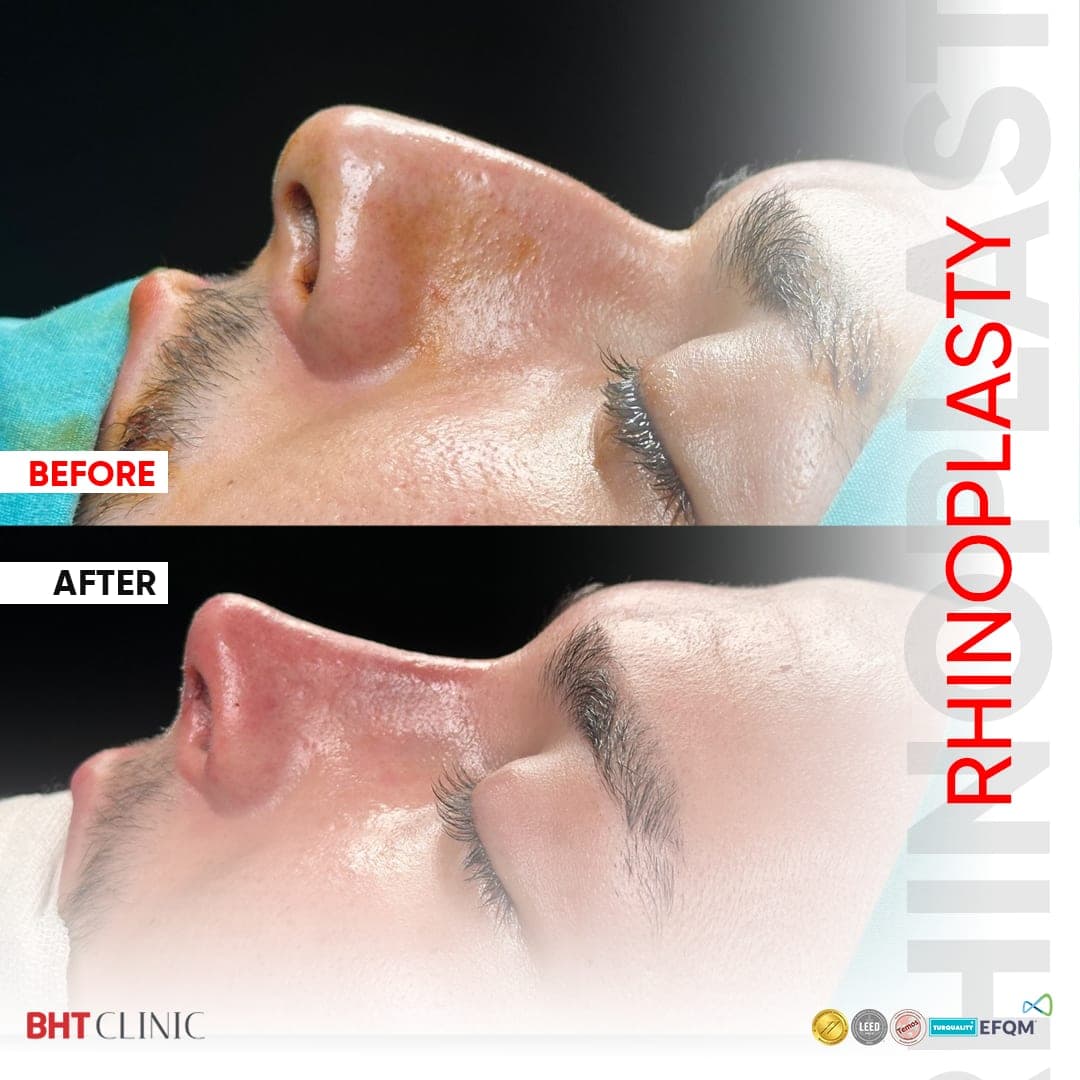
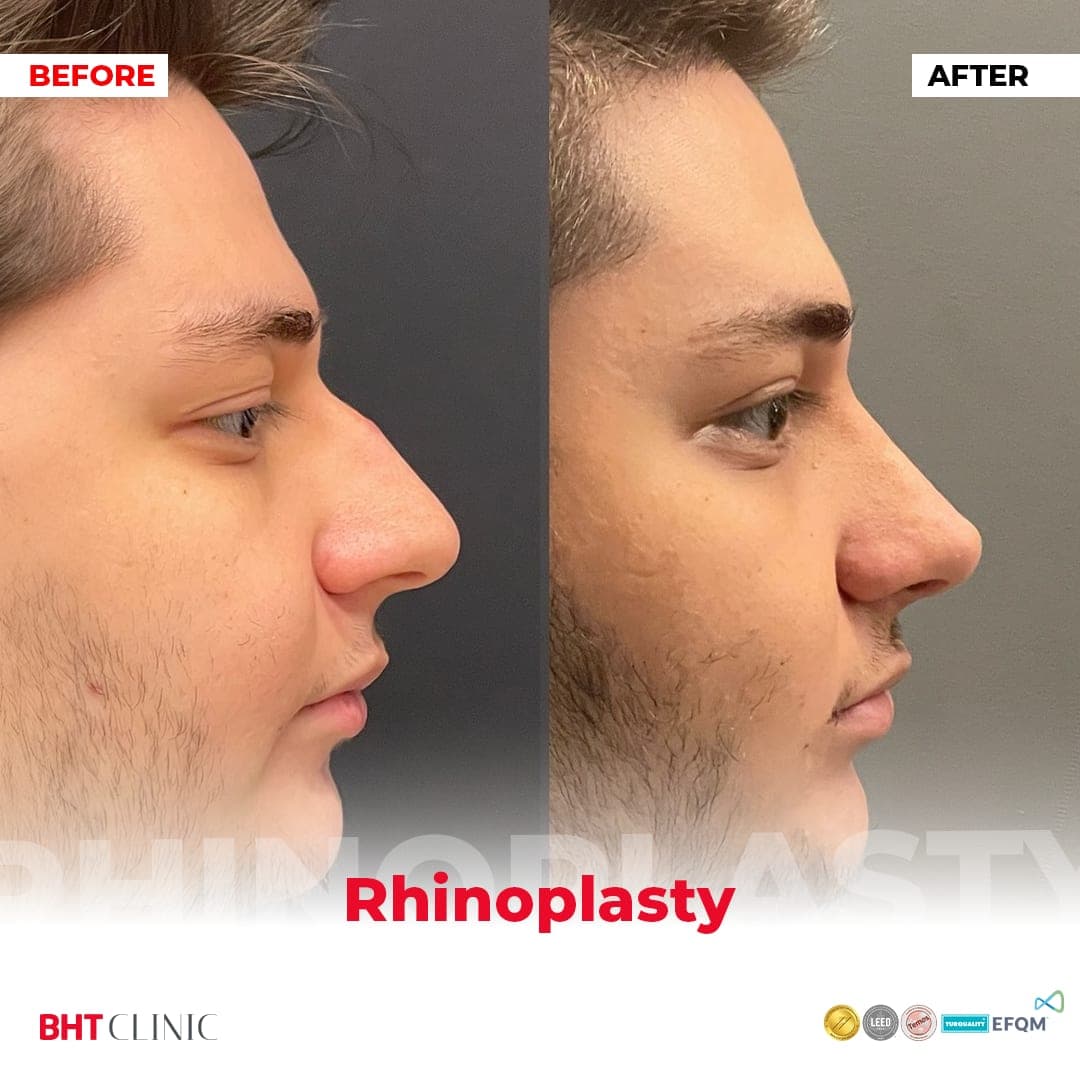
Real BHT CLINIC rhinoplasty patients, from photographs the hospital has published on its own channels. Every nose starts from a different bone, cartilage and skin thickness, so treat these as examples rather than a forecast for your own — what your surgeon can achieve is agreed with you on your own 3D plan. A fuller album is available privately on request.
Send a profile and a front photo — we'll show you before & after cases with a nose closer to yours.
BHT CLINIC is a JCI-accredited hospital group in İstanbul treating international patients across plastic, reconstructive and aesthetic surgery. Rhinoplasty is performed by a board-certified surgical team under general anaesthesia in a full hospital — with a consultant anaesthetist and intensive-care backup on site, not a day clinic. Patients from over 40 countries choose BHT for all-inclusive care: hotel, VIP transfers, an English-speaking coordinator or translator and structured aftercare.

Your stay in İstanbul
The stay is longer than most aesthetic operations for one reason: the splint stays on for about a week, and it is better taken off by the team that put it on than by a stranger at home. One night in hospital, the rest in your hotel, and your splint removed before you fly.
You will be met by one of our drivers at İstanbul Airport.
If your arrival time allows, you are taken to the hospital for blood tests and your consultation.
If you land late, or after your hospital visit, our driver takes you to your hotel to rest.
You will be met by one of our drivers at İstanbul Airport.
If your arrival time allows, you are taken to the hospital for blood tests and your consultation.
If you land late, or after your hospital visit, our driver takes you to your hotel to rest.
Your surgeon plans the shape with you using 3D imaging and confirms the approach — open or closed — that your nose actually needs. Nothing is booked until you have seen the plan.
Your operation is performed under general anaesthesia, with piezo ultrasonic instruments shaping bone rather than breaking it. Any septum work to correct breathing is done in the same operation.
You stay in hospital overnight with nursing observation. Most patients describe pressure and blockage rather than pain.
Your surgeon checks the dressing and your breathing before you are discharged to your hotel.
Bruising around the eyes is at its worst on days 2 and 3, then fades. You are up and walking, out to eat, and told to keep your head high and skip the gym.
Your coordinator is with you through the week for nasal cleaning, medication and anything that worries you.
The splint and any remaining dressing come off, your nose is checked, and you see it for the first time — still swollen, and that is expected.
Safe travels home with your taping instructions and your written aftercare — your coordinator stays reachable for 12 months.
Send a profile photo, a front photo and your travel dates — we'll come back with what our surgeons would do, your 3D plan appointment and your full schedule, in one WhatsApp chat.
Accredited & certified


All-inclusive packages
Fixed all-inclusive packages designed for international patients. No hidden fees — hospital, hotel, transfers, surgery and aftercare included.
All-inclusive
No hidden fees
Your price
€2,500
Package includes
All-inclusive
No hidden fees
Your price
€2,800
Package includes
Rhinoplasty in Turkey costs considerably less than in the UK, Ireland or Germany — largely because hospital and staffing costs are lower, not because the standard of care is. Our packages start at €2,500 all-inclusive, and the two tiers differ by the hotel, the hospital room and whether a personal coordinator stays with you. What that price does not vary by is the surgery: the same surgical team, the same hospital, the same anaesthetist. Send a profile and a front photo and you receive one written quote confirming your tier, usually within 24 hours, and it does not change once agreed.
Whichever your nose needs. A closed approach works entirely inside the nostrils and leaves no visible scar; an open approach adds a small incision across the columella, the strip of skin between the nostrils, and gives the surgeon direct sight of the tip cartilage. Open is usually chosen for complex tip work, marked asymmetry and revision cases. Your surgeon tells you which one they would use, and why, at your planning appointment — not after you have landed.
Piezo instruments use ultrasonic vibration to shape the bone of the bridge rather than breaking it with a chisel. Because they cut bone and leave soft tissue, cartilage and blood vessels alone, they allow finer reshaping and, in most patients, less bruising than classic instruments. It is a technique, not a different operation — it is used where the bridge needs work.
Yes, and it is common. A deviated septum, enlarged turbinates or a collapsing nasal valve are corrected in the same operation and under the same anaesthetic as the aesthetic work — one theatre visit, one recovery. Tell us at your assessment if you struggle to breathe through one side, snore, or sleep badly, so your surgeon examines the inside of your nose as well as the outside.
Less than most people expect. Rhinoplasty is not a particularly painful operation — the complaint is almost always pressure and a blocked nose rather than pain, and it is managed with ordinary painkillers. What you should plan for is bruising around the eyes, worst on days two and three, and the nuisance of breathing through your mouth for the first week.
Modern practice avoids the old gauze packing that made removal miserable. If internal support is needed, soft silicone splints with breathing channels are used instead, and they come out at your check. You will still feel blocked for the first week — that is swelling inside the nose, not the packing.
The splint stays on for about a week and is removed at the hospital before you fly, which is why the stay is planned at seven to eight nights rather than four. Flying with it on is possible but we would rather take it off ourselves, check the shape and show you how to tape at home. If your dates genuinely cannot stretch, tell us at the assessment and we will plan around it.
You see your nose at the splint removal, and it will still be swollen — most people are surprised by how much. The bulk of the swelling settles over six to eight weeks, the shape reads as itself at around six months, and the tip is the last part to finish, often taking a full twelve to eighteen months. Anyone promising you a final result at three weeks is selling, not planning.
Desk work at around two weeks, once the visible bruising has gone. Light cardio at about three to four weeks, heavier training and anything with a risk of contact at six to eight weeks — and glasses stay off the bridge until your surgeon clears them. Your discharge notes give you the dates in writing.
Yes, and revision work is planned differently — scar tissue behaves less predictably than untouched tissue, cartilage may need to be taken from elsewhere, and the honest answer is sometimes that waiting longer, or doing less, is the better plan. Send your operation notes if you have them, along with photographs from before your first surgery, and we will tell you what is realistic before you book anything.
In a full JCI-accredited hospital with sterile theatres, a consultant anaesthetist and intensive-care backup on site — not a day clinic. You are admitted for the night after surgery and discharged by your own surgeon.
You leave with your taping instructions, medication and written aftercare for the first month, and your coordinator stays in contact for 12 months. You send photos at agreed intervals, your team reviews them, and you can reach us on WhatsApp at any point. If something concerns you, we would rather hear about it early.