





international.bhtclinic.com.tr
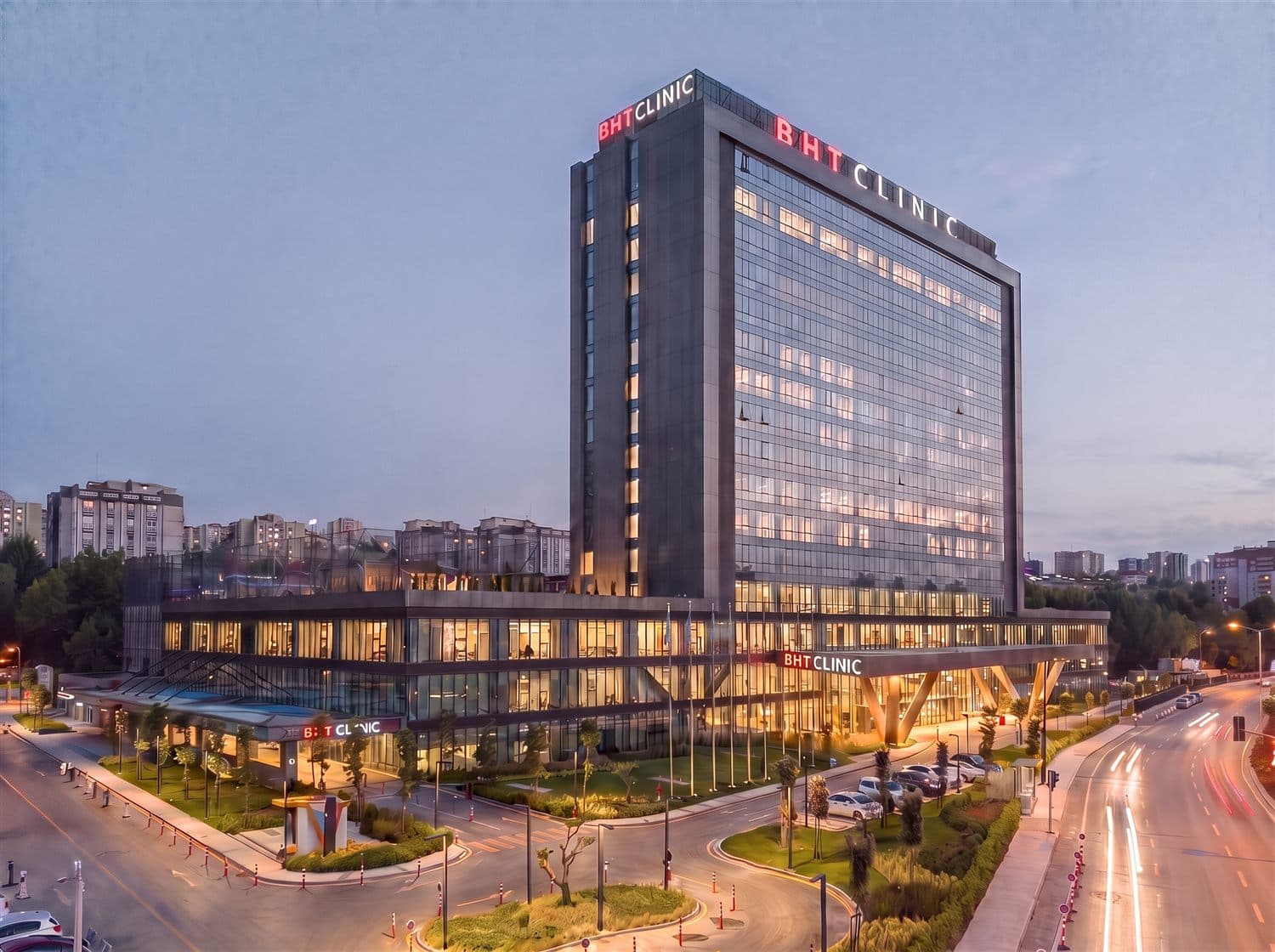
BHT CLINIC hospital, İstanbul
10,000+patients treated
Across all departments
JCIaccredited hospital
Joint Commission International

Smart Lens Surgery in Turkey

15+ years of surgery. 10,000+ patients treated across all departments of a JCI-accredited hospital in İstanbul. Trifocal and extended-depth-of-focus lens implants planned and performed by specialist ophthalmologists — with hotel, VIP transfers, translator and aftercare for international guests.

Accredited & certified

JCI accredited
TEMOS certified
EFQM
Turquality

Free assessment

Free Smart Lens Assessment

Send us your details — we'll tell you which lens option our ophthalmologists expect to discuss with you, and send your personalised plan on WhatsApp. Suitability is confirmed by a full eye examination on arrival.

We reply within 24 hours. Your details stay private and are never shared.

Patient photos

Smart lens surgery at BHT CLINIC — İstanbul

One photograph of a real BHT CLINIC smart lens patient, published by the hospital on its own channels. Results differ from one person to the next: which lens suits you, and what it can realistically do for your vision, is decided by your ophthalmologist after a full eye examination.

  • Smart lens patient at BHT CLINIC — before and after, photo 1
    BBHT CLINIC

    Smart lens patient at BHT CLINIC

    Smart lensAfter surgery

    A composite picture from BHT CLINIC's own channels: in colour, a patient sitting in a chair with both thumbs up; behind him in greyscale, hospital frames of a man in a surgical cap and gown with a protective pad taped over one eye, beside a masked member of the theatre team. The pad goes on at the end of the procedure and stays over the treated eye while it settles.

1/1
Personalised advice

Send your latest prescription and tell us what you struggle to see — we'll talk you through the lens options and what our ophthalmologists expect to discuss with you.

Ask About My Eyesvia WhatsApp

Discover BHT CLINIC

BHT CLINIC is a JCI-accredited hospital group in İstanbul treating international patients across eye and vision surgery. Smart lens implants, refractive lens exchange and cataract surgery are performed by specialist ophthalmologists in dedicated theatres inside a full hospital — not a day clinic. Patients from over 40 countries choose BHT for all-inclusive care: hotel, VIP transfers, a dedicated translator and structured aftercare.

BHT CLINIC hospital building, İstanbul

Your stay in İstanbul

Your 4–5 night smart lens journey

Your schedule adapts to your arrival time and to how the first eye settles — from airport pickup to departure, every step is planned for you.

Arrival at the airport

You will be met by one of our drivers at İstanbul Airport.

1 – 2 hours

Full eye examination

Biometry, corneal measurements, pressure and retinal checks at the hospital — the readings your lens is calculated from.

max 1 hour

Transfer to your hotel

If you arrive late, or after your hospital visit, our driver will take you to your hotel to rest.

Your journey starts here

Ready to plan your 4–5 night stay in İstanbul?

Send your latest prescription and your travel dates — we'll build your full schedule, from airport pickup to departure, in one quick WhatsApp chat.

  • Free assessment
  • Reply within minutes
  • No obligation

Accredited & certified

  • JCI accredited
  • TEMOS certified
  • EFQM
  • Turquality

All-inclusive packages

Transparent Pricing for Your Smart Lens Surgery

Fixed all-inclusive packages designed for international patients. No hidden fees — hospital, lenses, hotel, transfers, surgery and aftercare included.

Single Eye Package

All-inclusive

No hidden fees

Your price

On request

Package includes

  • Full eye examination, biometry and lens measurements
  • Lens surgery on one eye in a JCI-accredited hospital
  • Topical anaesthesia, with sedation if agreed
  • Intraocular lens — type chosen at your examination
  • Protective eye shield and post-operative drop set
  • Post-operative check before you fly
  • 3 nights accommodation in a 4-star hotel
  • VIP airport and hospital transfers
  • English-speaking patient coordinator
  • 12 months remote aftercare support
Get This Package via WhatsApp
Most popular

Both Eyes Package

All-inclusive

No hidden fees

Your price

On request

Package includes

  • Full eye examination, biometry and lens measurements
  • Lens surgery on both eyes, treated a few days apart
  • Topical anaesthesia, with sedation if agreed
  • Intraocular lenses — type chosen at your examination
  • Protective eye shields and post-operative drop set
  • Check between the two eyes and again before departure
  • 5 nights accommodation in a 5-star hotel
  • VIP airport, hotel and hospital transfers
  • Dedicated translator throughout your stay
  • English-speaking patient coordinator
  • 12 months remote aftercare support
Get This Package via WhatsApp

Premium Lens Package

All-inclusive

No hidden fees

Your price

On request

Package includes

  • Full eye examination, biometry, topography and retinal check
  • Lens surgery on both eyes, treated a few days apart
  • Trifocal or extended-depth-of-focus lenses where you are suitable
  • Toric correction for astigmatism where indicated
  • Topical anaesthesia, with sedation if agreed
  • Protective eye shields and full post-operative medication set
  • Check between the two eyes and again before departure
  • 5 nights accommodation in a 5-star hotel
  • Private VIP transfers throughout your stay
  • Dedicated translator throughout your stay
  • Personal patient companion
  • 12 months remote aftercare support
Get This Package via WhatsApp

Frequently Asked Questions

Lens surgery in Turkey costs considerably less than in the UK, Ireland or Germany — largely because hospital and staffing costs are lower, not because the standard of care is. Your price depends on whether one eye or both are treated and on which implant is used: a monofocal, a toric, an extended-depth-of-focus or a trifocal lens. We do not publish a single figure, because quoting one before we have seen your prescription and your measurements would be guesswork. You receive a written all-inclusive quote after your assessment, and it does not change once agreed.

It often does from about the age of 45, once the natural lens has stiffened and reading glasses have become necessary — laser reshapes the cornea but cannot restore near focus. A lens procedure is also considered where the cornea is thin or irregular, where the prescription is too high for laser to treat safely, or where a cataract has already started to form. Send your most recent prescription and any recent eye report and we will tell you what our ophthalmologists expect to recommend. It is confirmed by examination on arrival, and we will tell you if a lens is not the right answer for you.

A monofocal lens gives clear vision at one distance, so reading glasses are usually still needed. A toric lens corrects astigmatism as well, and can be monofocal or multifocal. A multifocal lens splits light between two focal points and a trifocal between three — distance, intermediate and near — while an extended-depth-of-focus lens stretches one continuous range rather than splitting it. Each design trades something away: broadly, the more focal points a lens carries, the more likely you are to notice halos and glare around lights at night. Your ophthalmologist recommends a lens based on your measurements, your work and how you actually use your eyes.

You may, and we will not promise otherwise. A trifocal or extended-depth-of-focus lens is intended to reduce your dependence on glasses at all distances, not to guarantee that you will never reach for a pair again. Many patients end up using glasses only for small print or long spells of reading; some use them more than that. What is realistic in your case is discussed with your ophthalmologist at your examination, before anything is agreed.

Many patients do at first, particularly with multifocal and trifocal lenses — rings or starbursts around headlights and street lamps in the dark. For most people the brain gradually learns to filter them out over a period of weeks to months, which is called neuroadaptation, and night driving becomes comfortable again. A minority stay aware of them. If night vision matters a great deal to your work, say so at your assessment — that is a genuine reason to consider a different lens, and your ophthalmologist will tell you so.

Yes. The natural lens is removed and the implant takes its place inside the eye, so it is intended to stay there for life — it does not wear out, and it cannot be cleaned or taken out at home. Because the natural lens has gone, a cataract cannot form in it again. The thin capsule the implant sits in can still cloud over, though, commonly months or years afterwards, and vision blurs in a way that feels much like the cataract returning. That is called posterior capsule opacification, and it is cleared in a few minutes with a laser in the outpatient clinic, without going back inside the eye. Exchanging an implant later is possible but it is a further operation inside the eye, which is why the choice of lens is made carefully beforehand rather than afterwards.

No — lens surgery is done one eye at a time. The first eye is treated and then examined before the second is scheduled, usually two or three days later, so that healing is confirmed and the calculation for the second eye can be refined if needed. That is why a lens procedure needs a slightly longer stay than laser treatment.

Yes, and it is one of the commonest reasons to consider one. Cataract surgery removes the clouded natural lens either way — the only question is which implant replaces it. Choosing a trifocal or extended-depth-of-focus lens at that point deals with the cataract and your reading prescription in the same operation. Whether a premium lens is suitable depends on the health of your retina and cornea, which is checked before anything is agreed.

In a full JCI-accredited hospital with dedicated ophthalmic theatres and medical backup on site — not a day clinic. Your examination, your surgery and your checks all happen in the same building, with specialist ophthalmologists and hospital-grade sterility.

Plan for 4 to 5 nights, so that your examination, both eyes and your final check all fit before you fly. The procedure itself takes around 20 to 30 minutes per eye under anaesthetic drops, and you go back to your hotel afterwards rather than staying in hospital overnight. Expect blurring, watering and light sensitivity for the first day or two, with vision settling over roughly a week and continuing to sharpen for several weeks after that. Most patients are back to desk work within about a week, and should not fly home before their ophthalmologist has signed off.

You leave with two or three types of drop — typically an antibiotic and an anti-inflammatory, sometimes a lubricant — on a schedule that begins several times a day and tapers over about four weeks. Following it properly matters, because it is the part of recovery you control. You are given the schedule in writing, and your coordinator stays in contact for 12 months: you send updates at agreed intervals and you can reach us on WhatsApp at any point. If something concerns you, we would rather hear about it early.